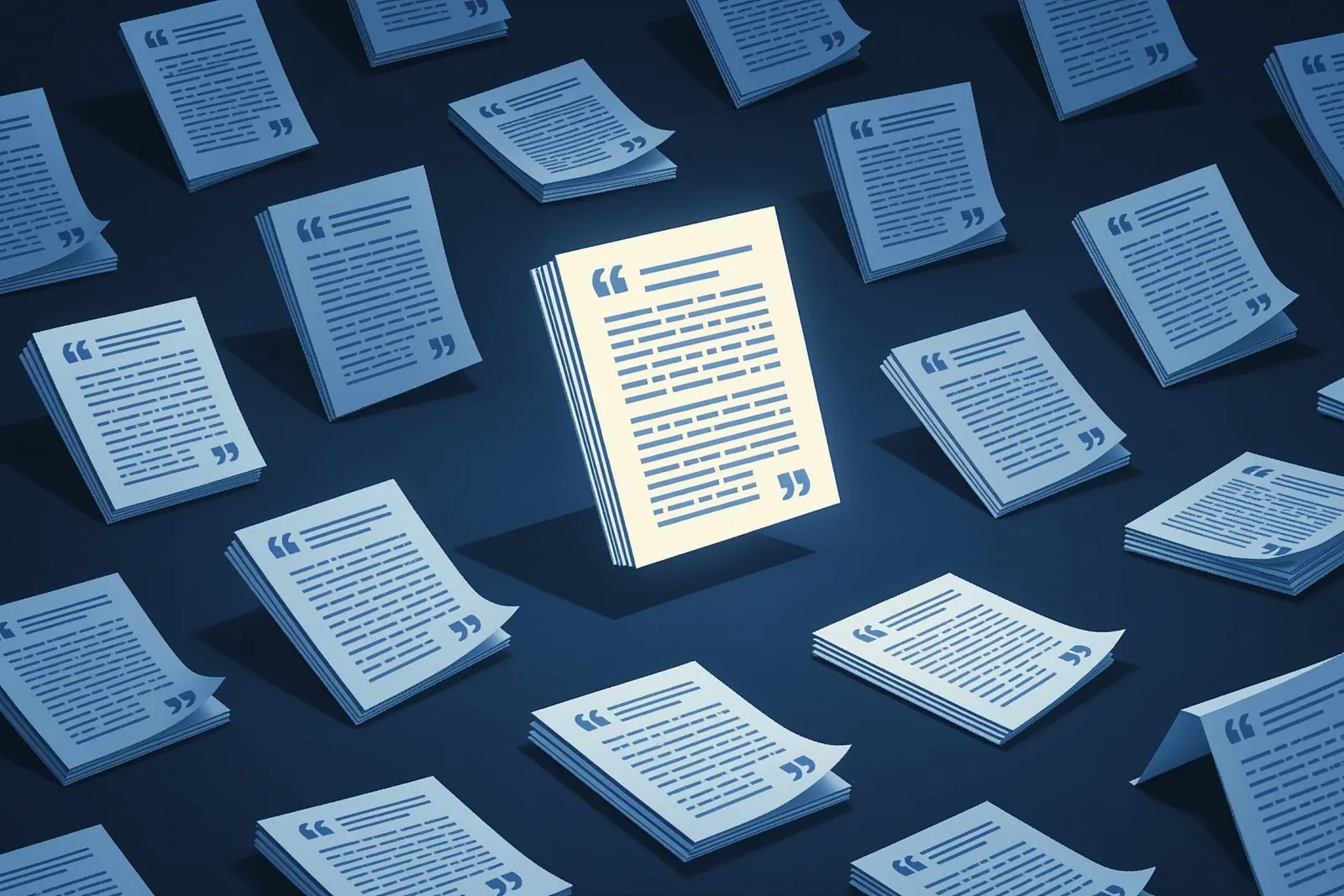
Two pages can cover the identical topic, at similar domain authority, and one gets quoted by ChatGPT far more often than the other. The difference usually isn't the underlying facts — both pages might contain the right answer. It's whether the specific sentence containing that answer can be lifted out of the page and stand on its own.
Quotability is a sentence-level property, not a page-level one
Most content structure advice operates at the page level — use headings, break up paragraphs, add a summary. That's necessary but not sufficient. The actual unit an AI system extracts and cites is usually a sentence or a short passage, not a whole page. A page can be well-organized at a macro level and still fail to produce a single genuinely quotable sentence anywhere in it, if every claim is wrapped in qualifying context that only makes sense read in sequence.
The test: pull any sentence out of your draft, delete everything around it, and read it alone. Does it still make a clear, accurate claim? Or does it need "this" or "it" or "as mentioned above" to mean anything? Passages that fail this test are invisible to extraction even when the surrounding article is accurate and well-researched.
Lead with the claim, not the context
The most common structural failure is scene-setting before the answer — two or three sentences of background, framing, or throat-clearing before the actual point arrives. A retrieval system scanning for the answer to "what's the ideal image size for AI Overviews" is looking for a sentence that states a size, not a paragraph that starts with "When thinking about image optimization for modern search experiences, it's worth considering..."
Invert this. State the claim first, in the first sentence of a section, then use the following sentences for the context, caveats, and reasoning that a human reader benefits from but a citation doesn't need. This single change — answer first, context after, rather than context first, answer buried — is consistently the highest-leverage edit available on already-accurate content.
Specific beats accurate-but-vague
"Image size matters for AI Overviews" is true and useless as a citation. "AI Overviews commonly source images at least 1200px wide" is a specific, attributable claim a model can quote with confidence. Vague, hedged statements — even when technically correct — give a retrieval system nothing concrete to extract, because there's no specific fact being asserted. Where you genuinely know a number, name, date, or threshold, state it plainly. Reserve hedging for cases where you're genuinely uncertain, not as a default writing habit.
This doesn't mean overstating confidence in claims that are actually uncertain — a wrong specific claim is worse than an honest vague one. It means: when you do know something specific, say it specifically, rather than softening it into vagueness out of habit.
Match headings to how people actually ask
A heading like "Technical Considerations" tells a retrieval system almost nothing about what question the section answers. A heading like "How long does image indexing take?" maps directly onto how someone would phrase that question to an AI assistant. Retrieval systems weigh semantic similarity between a query and nearby headings heavily when deciding which chunk of a page to pull from — a mismatch between how you titled a section and how people actually ask about that topic is a straightforward, fixable way to lose citations you'd otherwise win.
Apply this while writing, not just while auditing
It's tempting to treat this as a one-time editing pass over existing content, and that's worth doing — but the bigger win is building the habit into first drafts. Every time you write a section, write the direct, self-contained answer first, as if it might be lifted out and quoted with nothing else around it, because increasingly, it might be.